|
 |
 |
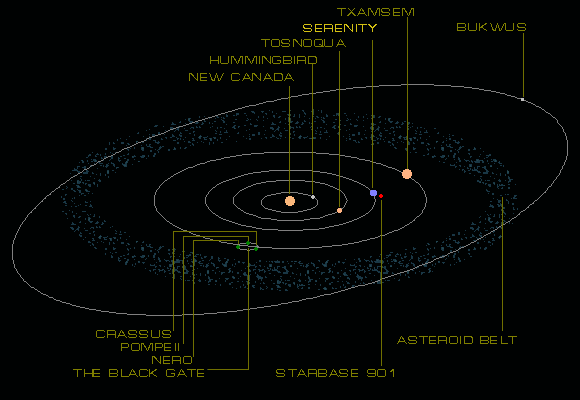
Celestial bodies in the New Canada System are named after figures from the mythology of the ancient Canadian Indians on Earth. The Hummingbird was a symbol of beauty and intelligence. It was known as the messenger of the spirits. |
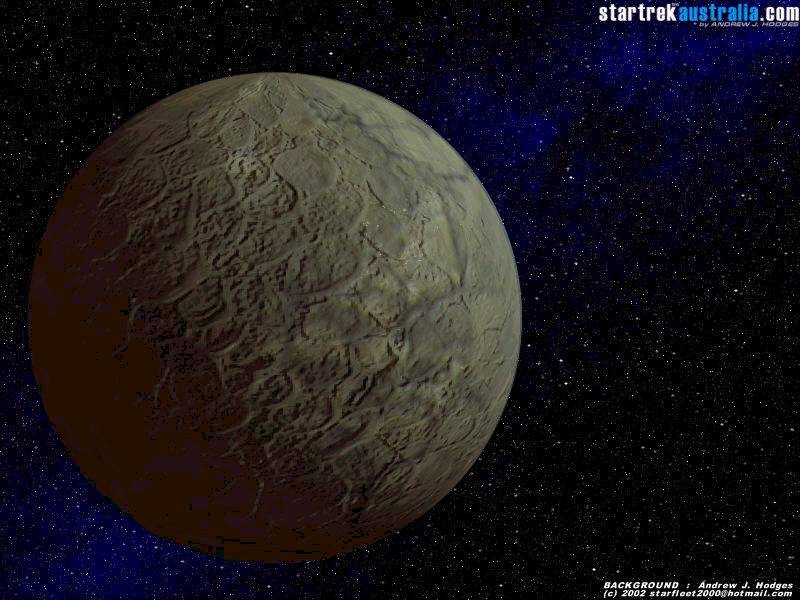
The surface of Hummingbird is crisscrossed with cracks in the planet's crust, huge chasms 10 km wide and up to 100 km deep, some reaching almost down to the mantle. These rifts separate the surface into a myriad distinct plates, giving Hummingbird its distinctive appearance, somewhat like dried, cracked mud on a dry lake bed. Each plate is approximately 500 km across. It is not known by what geological process this peculiar fracturing occurred, but it is theorized that at some point in the distant past, the planet suffered a massive internal explosion, just short of being powerful enough to destroy it completely. After the explosion, the planetary fragments reassembled themselves under their mutual gravitational pull, giving Hummingbird its cracked appearance.
To date, no forms of life have been discovered on Hummingbird, and no evidence has been found that any ever existed.
Humingbird's tenuous atmosphere consists of trace amounts of oxygen baked out of the rocks by the intense heat, and hydrogen temporarily trapped by gravity from the solar wind.
Since Hummingbird's day is exactly as long as its year, one side of the planet is always facing the sun and the other side always away from it. That makes predicting the weather very simple: on the day side it's hot and on the night side it's cold. Temperatures range from +250° to -170° Celsius
No permanent settlement has ever been set up on Hummingbird, but facilities exist on the equator just across the terminator on the dark side for visiting scientific research teams. Any visitor is strongly advised to invest in a high quality, reliable life support system.