|
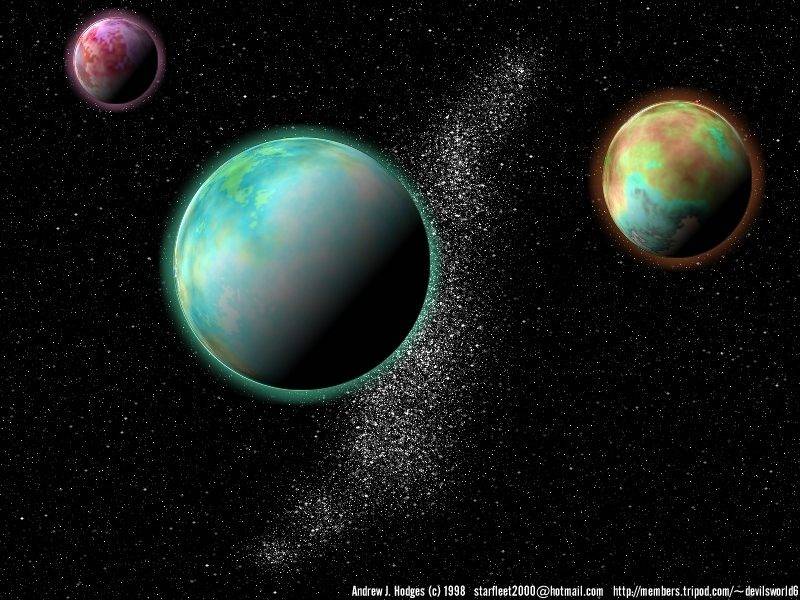 |
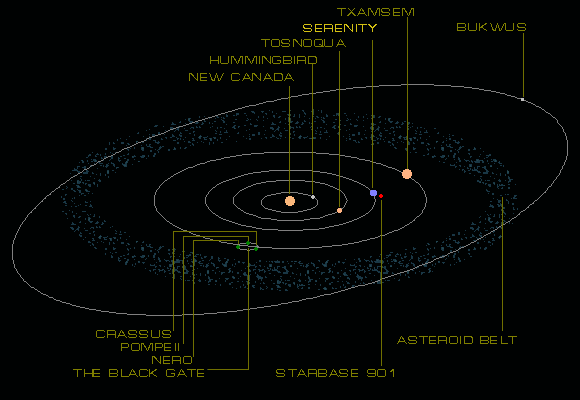
Crassus, Pompeii and Nero orbit the trio's common center of gravity, and as a group they orbit the New Canada sun in the trailing Trojan position behind the fourth planet, Txamsem. While the L5 Lagrangian position behind the gas giant is a natural gravitational collecting point, the arrangement as a whole is not a stable one, and it is not understood how they maintain their equilibrium without either falling into the sun or Txamsem, or spiraling out of the system altogether! It is possible the Black Gate, an artificial wormhole apperture, has some unknown effect on the orbits of the Trojans, holding them in place.
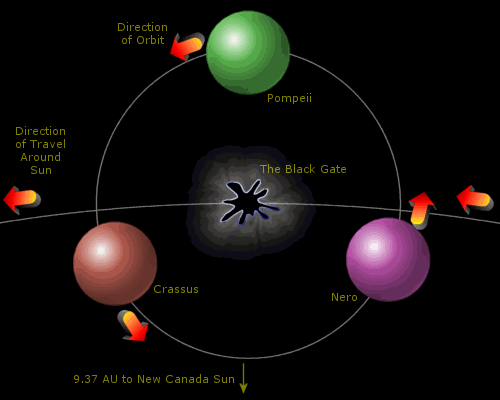
The Black Gate is a 21-dimensional space/time/thought discontinuity. The apperture is always open, but is invisible (hence the name). The destination of the wormhole is determined by the orbital positions of the three Trojan Planetoids around it, and its position in relation to the sun at the moment of entry.
Geologically, the three planetoids are identical, but not understood. It is not clear how a planetoid less than half the size of Earth can have almost the same gravity and atmosphere, yet Crassus, Pompeii and Nero do, suggesting a super-dense core of unknown composition. The surface rocks are basaltic, and show little sign of erosion due to the absence of any appreciable weather or running water.
Biologically, the three planetoids are almost identical. The dirt and rocks of the planetoids is completely sterile—plants will not grow in it. No native life has been detected with one possible exception: Pompeii is home to a whimsically (but aptly) named life form called 'Smelly Jelly', but it is suspected that it is not native to the planetoid. How it came to be here is not known. Crassus and Nero are completely barren of anything living.
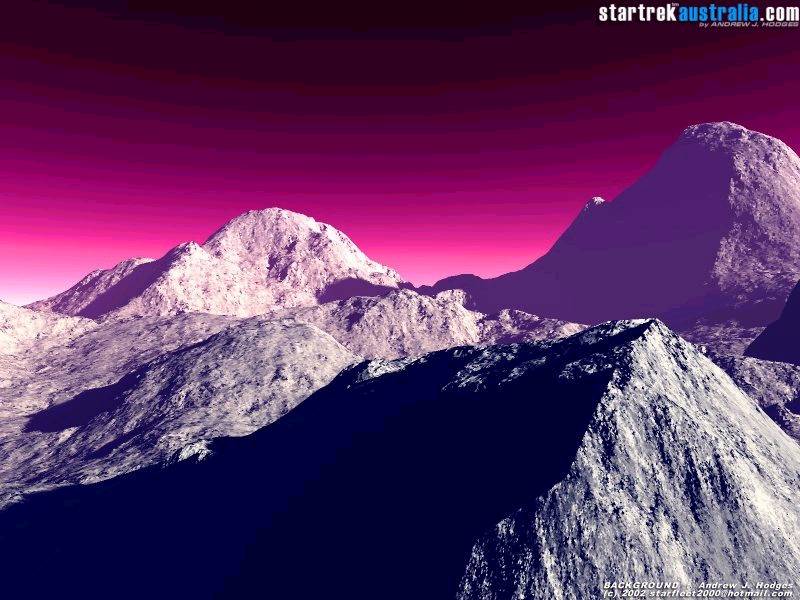
Meteorologically, the three planetoids are identical. An atmosphere one-and-a-half times as thick as Earth's with abundant greenhouse gasses helps to insulate the planetoids from the cold of the outer solar system, trapping the distant sun's feeble rays near the surface, enabling the temperature to rise to livable levels. Because of the low solar radiation, winds rarely rise above a few kph. There is a complete absence of water in any form. Atmospheric mottling is therefore not caused by water clouds, but by high-altitude dust clouds lifted into the relatively thick upper atmosphere by occasional dust devils.
Currently, there are no human habitations on any of the three planetoids. Only the initial survey teams from Starbase 901 have visited the trio, and landed only on Pompeii. The air is marginally breathable, but the complete lack of water would make establishing any permanent settlements difficult.
The three planetoids of Serenity are a complete enigma—by all the known rules of planetary development, these three bodies should not exist. Only one other similar planetoid was ever discovered by the Federation: a Kalandan Outpost discovered by the USS Enterprise (NCC-1701). The outpost was artificially created by the advanced but extinct Kalandan race 10,000 years ago. An artificial origin would explain the planetoids' impossible properties, but it still remains to be discovered how such a technological marvel was achieved, and who was responsible. Another possible theory that has been put forth is that the builders of Crassus, Pompeii and Nero are one and the same as the ancient builders of 'The City' on Tosnoqua.