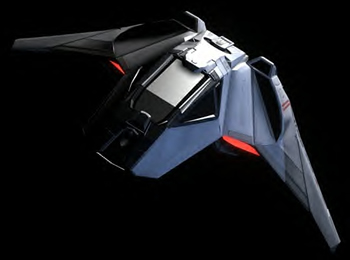
| Class Name |
Valkyrie |
|
| Type |
Escort fighter |
|
| Dimensions | ||
| Length |
20 meters |
|
| Wingspan |
14 meters |
|
| Height |
3.5 metres (Undercarriage retracted) |
|
| Mass |
19 tons |
|
| Crew |
1 Pilot, 1 CM Officer |
|
| Armaments | ||
| Offensive |
2 x Type V Phaser Cannons |
|
|
1 x Quantum Torpedo Launcher (10 Torpedoes) |
||
| 2 x Micro-Torpedo Launchers (20 Torpedoes each) | ||
| Defensive |
Standard Type II Shield System |
|
| Union Shielding interface | ||
|
Parametallic Hull Plating (3.2 cm) |
||
| 3 x Counter-Measure Launchers | ||
| Propulsion | ||
| Warp |
2 x Warp Engines |
|
Cruise Speed |
Warp 4.2 | |
| Maximum Speed | Warp 6.2 | |
Emergency Speed (Five Hours) |
Warp 7.5 | |
| Impulse | 2 x Impulse Engines | |
| Maximum Speed | 0.8c | |
| Cruising Speed | 0.4c | |
| Atmospheric Engines | 2 x ScramJet engines | |
| Maximum Speed | Mach 5.1 | |
| Cruising Speed | Mach 3.5 | |
| RCS |
12 x Reaction Control Thrusters |
|
The Vallkyrie with a pair of forward facing type V phaser cannons with a combined output of 130 Terrawatts per second, two wing mounted micor-torpedo launchers and a centrallly mounted quantum torpedo launcher.
Phaser Cannons
The Type V phaser cannons are the most powerful weapons installed on any small vessel and it is only due to the design of the fighter's central power core that these weapons actually operate.
Quantum Torpedo Launcher
The quantum torpedo launcher on the Valkyrie is located in the bow of the vessel and is a self-contained unit holding 10 torpedoes. This makes installing and removing the unit faster, leading to a quicker turn around under battle conditions.
Micro-Torpedo Launcher
Under each wing of the Valkyrie is a second self-contained torpedo launcher, these units firing micro-torpedoes. Each unit contains 20 torpedoes.
Standard Type II Shield System
The Valkyrie is fitted with a standard type II shield system, which is normally only installed on small personnel vessels. Whilst this system is sufficent for non-combat situations, is is the one serious weakness of the vessel. However, because of the limited power requirements for the shields, more power is available for the weapons and the engines.
Union Shielding System
To combat the weakness of the Valkyrie shields, a unique secondary system was developed known as "Union Shielding". This system explotes the fact that the fighters was primarily designed to be used in groups rather than as individual vessels.
This system allows a 'group shield' to be created around the entire squadron, where each vessel contributes power to the unified shield. When more power is required to recharge the shields, the system is capable of taking power from the vessels with the lowest power requirements.
This system's effectiveness increases the more vessels are in the group, because less energy is required from each vessel to maintain the shield. Other vessels have also been equipped with this system, interlocking with the fighters.
Parametallic Hull Plating
The second way the Valkyrie fighter makes up for its weak shields is with 3.2 cms of parametallic hull plating, which is twice as resistant as tritanium hull plating to damage. Parametallic hull plating is not as resistant as ablative armour, but is only half the weight.
Counter-Measure Launchers
The Valkyrie has an extensive range of counter-measure devices onboard, from simple decoy buoys to micro-mines. These systems are again self-contained allowing quick replacement under combat situations.
The main power plant is a modified Type IV shuttle warp core, which was built using the latest nano-technology construction techniques. This has resulted in a more compact and efficient power core which has aided in reducing the weight of the entire fighter without a severe loss of power.
Interstellar Propulsion System
The Valkyrie has standard two warp engines, each warp coil having been constructed using the newly developed Tri-tungsten-cobalt-magnesium alloy. This has resulted in and increase in the amount of power absorbed into the coils by 60%, increasing the effiiciency of the warp engines by nearly 40%.
This system means less power is required to maintain a higher warp factor and the Valkyrie is the fastest vessel for it's size and weight.
Impulso Engines
The twin impulse engines make the Valkyrie very fast at sub-light speeds. The Valkyrie can outpace most known vessel in normal space, thanks to the increased power that can be drawn from the power core.
Atmospheric Engines
The Vakyrie is fitted with twin Scram jets, allowing the fighter to attain hypersonic speeds within an atmosphere. The Scram jets can operate at altitudes upto 120 miles, after which the impulse engines can be used to break orbit.
Reaction Control System
The Valkyrie has twelve rather than the usual eight RCS thrusters. These twelve thrusters make the Valkyrie highly manoeuvrable, when acting in concert.
Many of the systems onboard the Valkyrie are semi-automated, including the shielding system, which can monitor and react to a potential threats and the reaction control systems which co-ordinate the firing of the RCS thrusters.
The following ship systems are slightly modified versions of standard ship systems.
- Inertial Dampeners
- Structural Integrity Field
- Navigational Deflector
Designed as a replacement for the ageing Peregrine class fighter, the Valkyrie class fighter is smaller and more agile. The Valkyrie can be used for a variety of missions from planetary assault to dog fighting. Unlike the Peregrine class, the Valkyrie has been designed to be used in groups, rather than as independent vessels.
The Valkyrie's primary role is as an escort fighter, flying support for other larger vessel such are transports, runabouts or starships. The vessel is however highly manouverable and fast at sub-light speeds making it an ideal interceptor and light strike fighter when deployed in numbers. The vessel is also more than capable of operating in an atmosphere with little loss of performance.